Let’s talk about Nicki Minaj and the pro-vaccine population. Yesterday, an uproar in the media happened when Nicki announced she wasn’t going to the MET Gala.
Now, as someone who enjoys a good amount of her music, and having been one of her supporters during the start of her career in the 2000s, I’ve always admired her work ethic, her maturity on certain situations, and her recognition of what Black women face in the US.
Though her body of music isn’t necessarily Christian-friendly, her personality and her point-of-views (which are often similar to mine), is something I related to. So, when I saw the news article stating Nicki was ‘anti-vax’ and misleading people about the vaccines, naturally I had to do my research about it.
Notice I used the word ‘research’.
So, what did I do? I read through Nicki’s tweets to see what she said about herself.
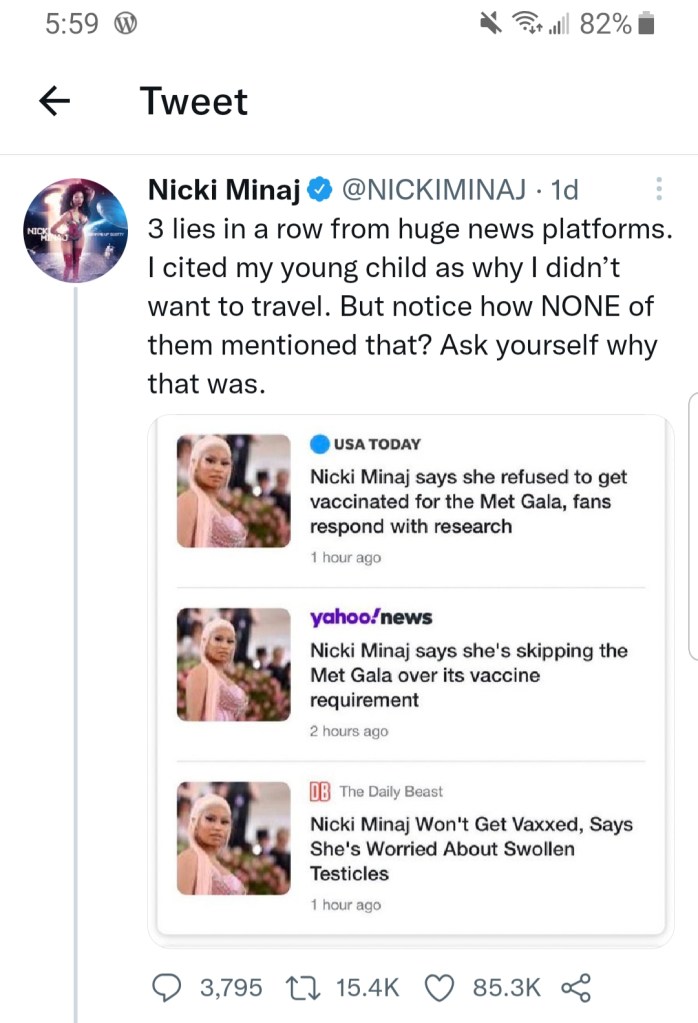
What I learned was the media had taken everything she said out of context. Nicki contracted COVID, and due to her contracting the virus and recovering, she decided not to attend any public events, which included the MET Gala. She was thinking about her safety and her family’s safety—especially the safety of her young son.
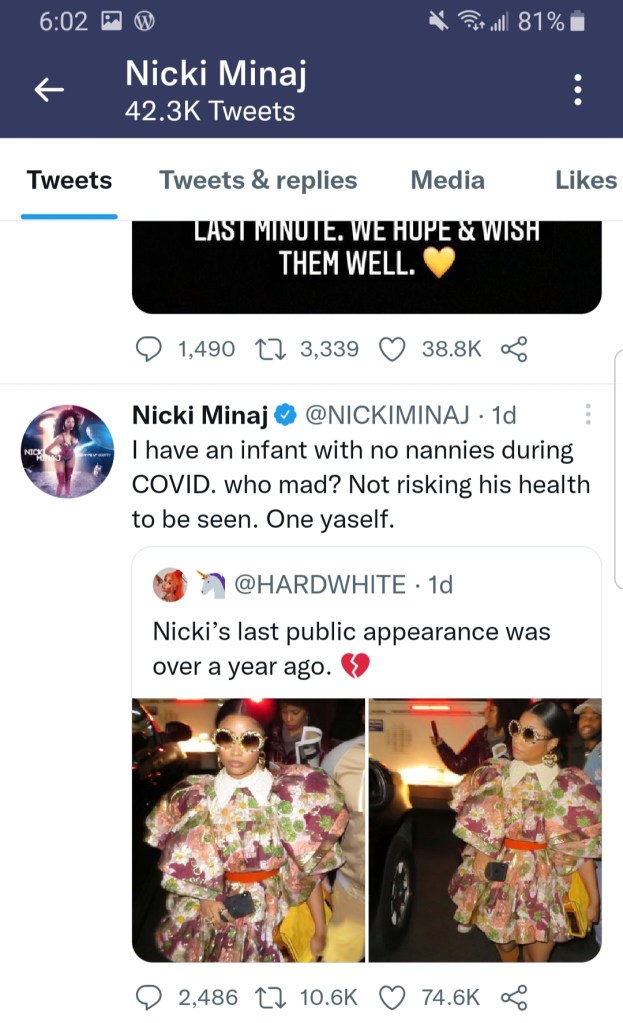
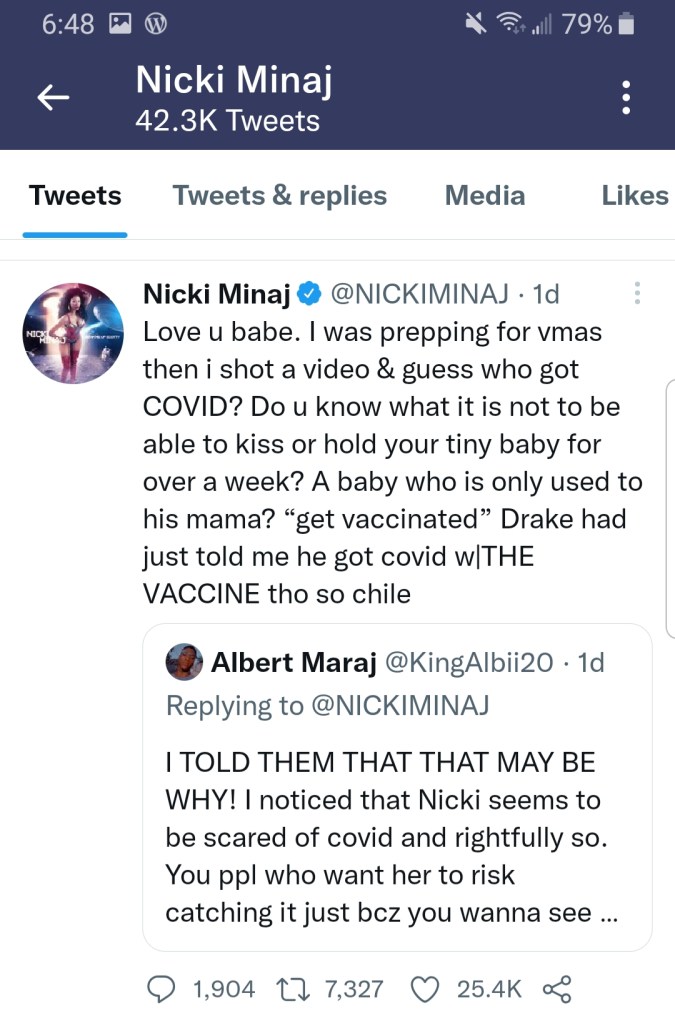
Now, she wasn’t vaccinated, and she still said she needed to do more ‘research’ on it, and since the MET required attendees to be vaccinated, she wouldn’t be able to attend in any case. Her decisions to not attend the MET Gala wasn’t based on the fact that the MET required vaccines—it was based on the fact that she couldn’t afford to contract COVID due to having a young child and not being vaccinated as set.
Her reason for not being vaccinated—she felt she didn’t do adequate research to make a decision.
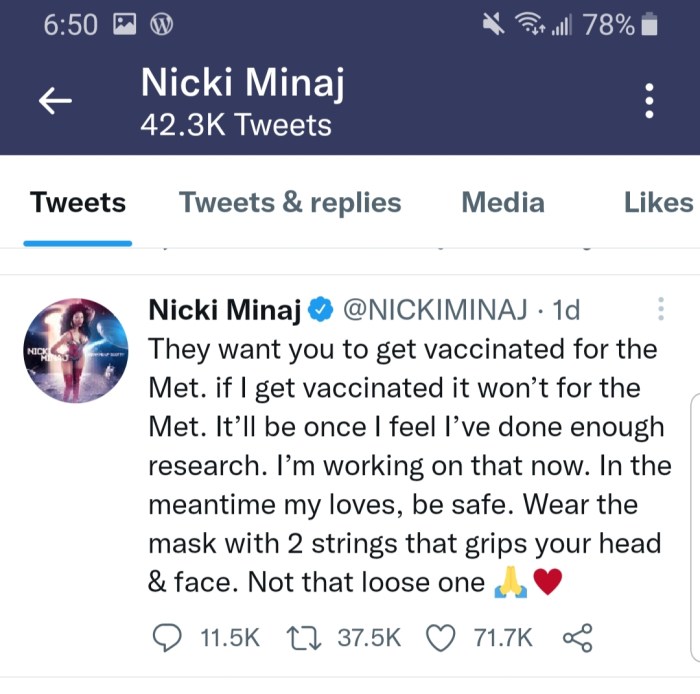
But people are still saying (including the media) that she’s only instilling fear of the vaccines (despite encouraging people to get it and even saying she will soon get the vaccine) and that enough research has already been done.
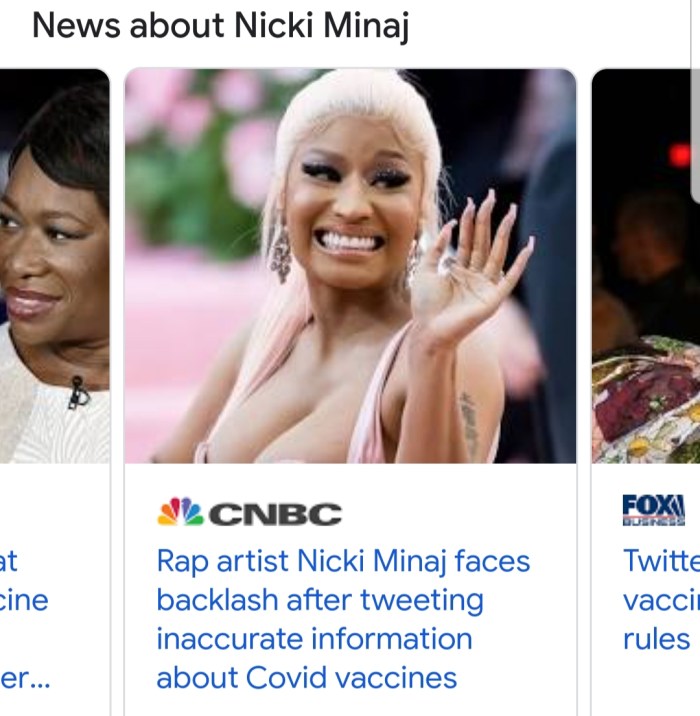
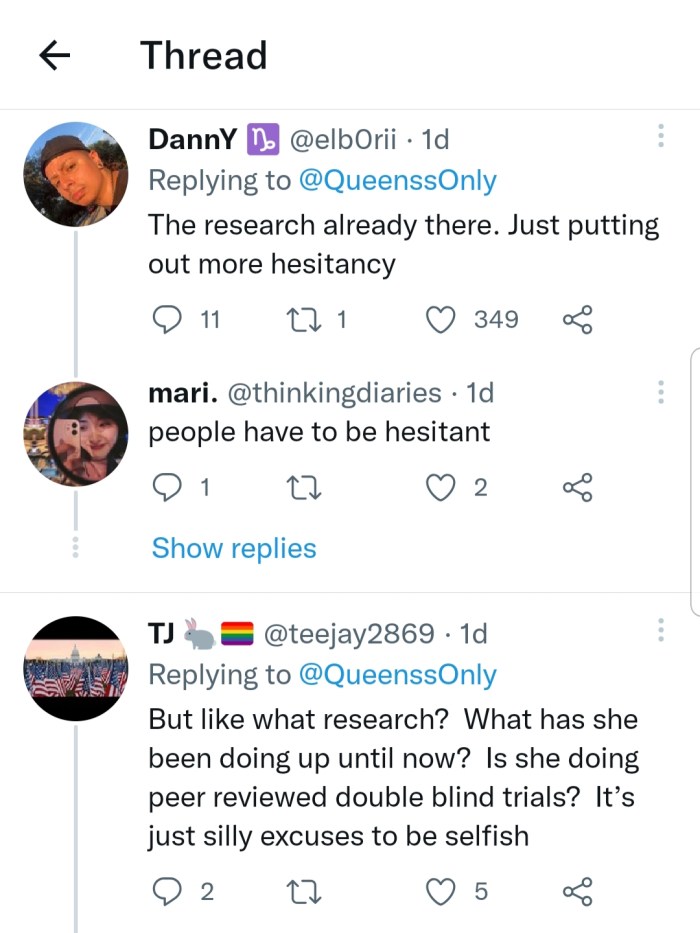
Yes, research has been done—but Nicki wasn’t able to read those research articles yet to fully inform herself, and thus, she decided not to get the vaccine.
Before I got the vaccine, I felt I needed to do research. This included reading what the CDC and scientists, and doctors said about the vaccine. This included fully understanding what mRNA technology was. This included which vaccines were the best for me to take. This included learning the purpose of the vaccines, the time between the two dosages, and what were the side-effects and risks of taking the vaccines.
I needed to be informed of all this from the right sites, not from Twitter, Facebook, and other people telling me I should take it.
I remembered hearing the rumors that the vaccine caused infertility in women, and I was a bit nervous. I felt I needed to research it. This meant hearing what scientists say about this myth and seeing evidence that women were able to conceive after getting the vaccine. When I felt I was fully informed, I got my vaccine.
I knew I would get it, but I wanted to get it after I educated myself on it—not because of politicians, my job, airlines, or other people told me so. People have a right to be informed about something before they go ahead and do it.
This was all Nicki wanted to do. She wanted to be fully informed before she made the decision—she knew she would eventually get vaccinated, but that decision would only be made after she properly read through and informed herself on it—not from word-of-mouth.
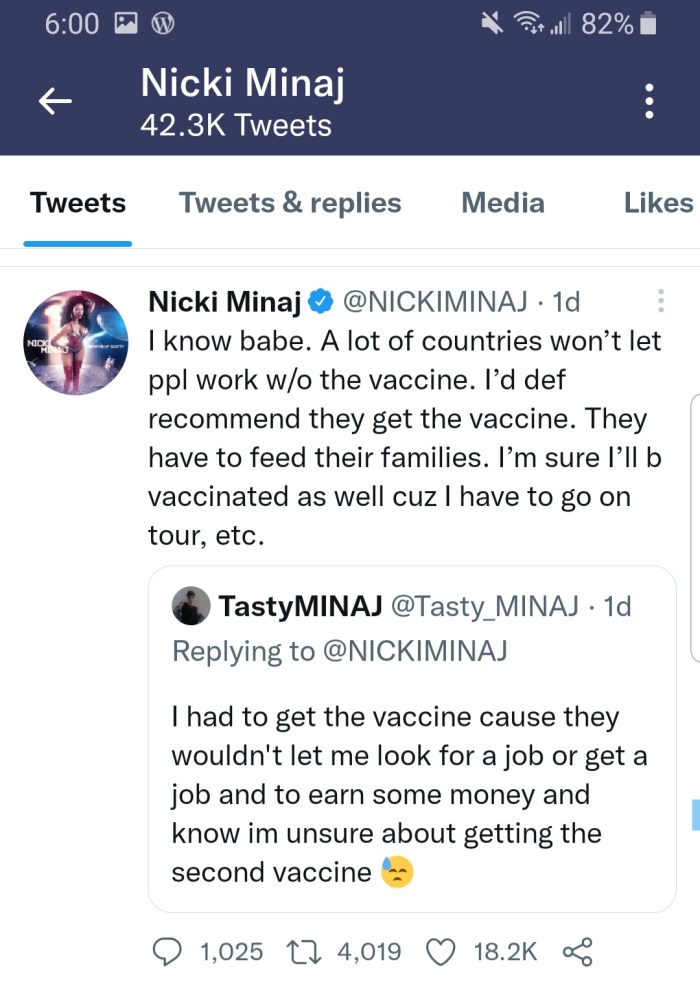
But this statement she made caused a debate from the ‘pro-vax’ community, who shames anyone for wanting to research something. You’re supposed to want to research. That doesn’t make you anti-vax, that makes you more informed about what you’re doing.
People often conflate research with scientific studies and experiments. Science conducts research, then provides a hypothesis and proceeds to run tests and experiments to support their claims. That is scientific study. They did this with the vaccine, but now the person taking the vaccine has to conduct their own research.
This means informing themselves of what scientists have said, comparing it to other alternatives, and then forming a hypothesis based on what they’ve researched—their hypothesis may conclude the vaccine is safe and effective or it may not.
But encouraging people to research, read, and inform themselves on something, whether it be talking to their doctor, reading CDC’s website, or learning more about mRNA technology and how it is used, should always be encouraged. Rather than shaming people for wanting to learn more, why not provide links to articles they can read to further inform themselves?
Nicki’s issue highlighted a major problem surrounding vaccination and vaccine-hesitancy. It highlights people’s willingness to berate and tear-down anyone who unsubscribes from a hive-mind attitude about anything that is pushed by the medical industry.
We ought to remember the times when doctors encouraged people to smoke, thought that draining blood would cure diseases, and drilled holes into the heads of people who were suffering mental illnesses. Medicine is ever-changing, but it can only be ever-changing if we as a people continually challenge them, and this often means becoming skeptics.
If we weren’t skeptical about the medical industry, and just accepted anything they told us, who knows where we would be? It is often our skepticism that allows for drug recalls. It was our skepticism that showed the vaccine could cause blood clots. It was our skepticism that allowed for more studies into rare diseases.
You should never stop being a skeptic just because you’ve come to a personal decision about something, and you should never demonize others who are skeptical about certain things that are being pushed in the media.
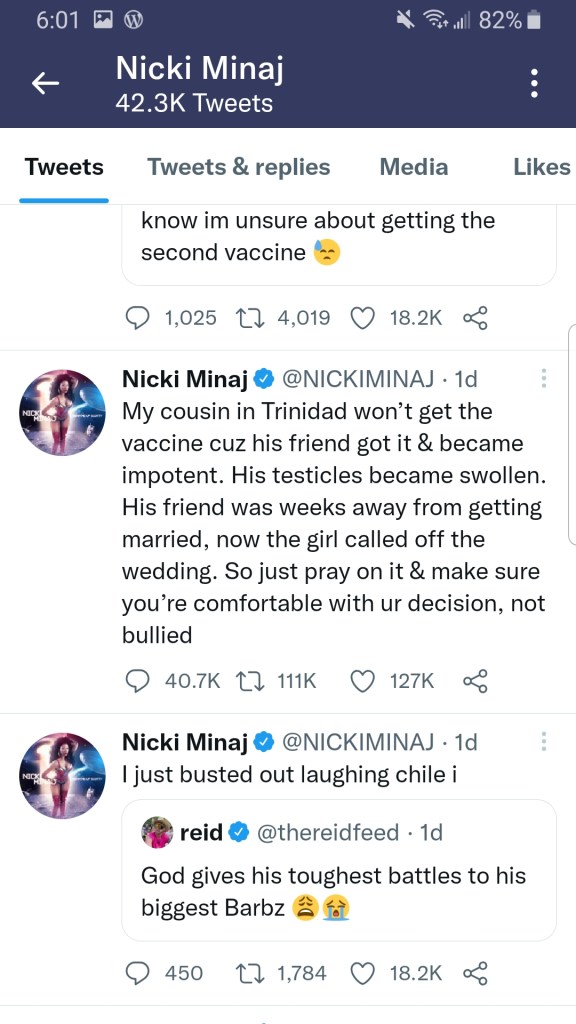
But, in the above photo, notice she said something that I think is very key to practicing before making ANY decisions in life—‘pray on it and make sure you’re comfortable with your decision’.
This was something my mother told me when I was worried on whether or not I should take the vaccine, and I think this is the most-important and biggest take away from her message—
Pray over any decision you’re about to make.
P.S. Her comment about her cousin’s friend’s ‘situation’ with the vaccine could simply have been a pun-intended joke based on a previous tweet she’d commented on. (Also, I’m vaccinated, so obviously, this isn’t an anti-vax post).

Strengthen your faith and grow with God. Get new bible-study content delivered right to your inbox.




 The RAVYN Blog