As far back as Christian scholars could go, it’s been widely accepted that the Trinity and the early church coincided.
The doctrine of the Trinity was taught to ensure that new believers understood the roles of the Father, Son, and Holy Spirit in their salvific journey. The problem is that the word ‘trinity’ isn’t written plainly in the Scripture.
Yet, what wasn’t written plainly is now seen as the core foundation of our Christian faith. Those who don’t believe in the deity of the Father, Son, and Spirit are branded as heretics, while those who do believe in this sometimes misunderstand that they are, indeed, separate persons.
Those who consider themselves Trinitarians firmly believe that the Scripture supports this doctrine. Is it true? If so, where did this word come from, and why do we use it to define God?

Where Did the Word ‘Trinity’ Come From?
Some people ask Where does the word ‘trinity’ come from?’ as an argument against the validity of the doctrine.
In fact, those who argue against the Trinity claim that since the word can’t be found in the Bible, then the doctrine itself isn’t true. It’s a good point to make. However, none of the 66 books of the Bible were written in English, and translators did their best to ensure we can read the text in a language common to us.
The reality is that most of the words we use today in our theological growth aren’t exactly in the Bible. We do our best to translate words to the closest ones we know. We could attribute the use of the word ‘Trinity’ in our theological language to a man named Tertullian.
Who is Tertullian and Why is He Important?
Tertullian was an African (Berber descent) church father who hailed from the province of Carthage. He was considered the father of ‘Latin Christianity’, and his work and research laid the foundation for many foundational doctrines, including the trinitarian doctrine.
Tertullian coined the word ‘Trinity’ for two reasons:
- He wanted to fight against Christian Gnosticism and heresy; as an avid apologist, he believed in maintaining the authenticity of the Scripture as it was taught.
- He needed a word to describe the unique yet complex relationship among the Father, Son, and Spirit; he stated that these three persons were distinct from one another yet one God.
The Invention of ‘Trinitas’
To explain this unique relationship, Tertullian used the Latin word ‘trinitas’ to combine what he considered the ‘substansia’ and ‘persona’ of God.
Here is what scholars had to say about Tertullian’s use of the word ‘trinitas’ to describe the nature of God.
Though Tertullian considered the Father to be God (Yahweh), he responded to criticism of the Modalist Praxeas that this meant that Tertullian’s Christianity was not monotheistic by noting that even though there was one God (Yahweh, who became the Father when the Son became his agent of creation), the Son could also be referred to as God, when referred to apart from the Father, because the Son, though subordinate to God, is entitled to be called God “from the unity of the Father” in regards to being formed from a portion of His substance[a].

Follow the RAVYN Blog on Pinterest
Discover what the Bible says about the Trinitarian Doctrine!
Follow us on Pinterest to learn more about God’s Word.
The Complexity of the Trinitarian Framework
Tertullian’s work in the early Church established a standard among Christian believers for understanding the finished work of God.
This doctrine was already in place and had been taught for several years, but there was never a word or term to describe it. Most Christians up to this point had accepted this doctrine, so the idea of God’s triune nature was not unique to them.
In fact, Judaism already had a concept of God’s duality, as evidenced by the book of Daniel and its analysis of Daniel’s vision of the Son of Man who approached the Most High.
Today, Christian theologians use the chart below to describe the nature and relationship of the persons within the Godhead.
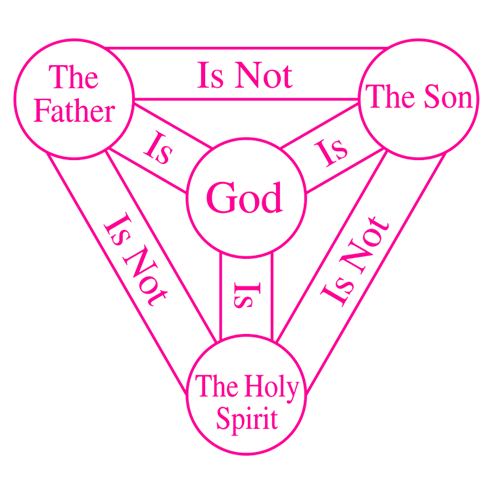
However, while a visual like this often gives us an idea of what we believe, wrapping our minds around it is where the issue lies.
Why Does the Trinitarian Doctrine Matter?
There are two things to consider when talking about the doctrine:
We won’t be able to explain the Trinity in a way that the logical brain can comprehend without first understanding who God is.
We need to explain how this doctrine is necessary to our understanding of salvation.
In fact, I’d argue that when many people share the Gospel, they tend to exclude (not always deliberately) the role of the Father and the Spirit. Most people walk away thinking that Jesus, who, yes, is God, is the *only* person in the Godhead. They tend to neglect the true purpose of Christ’s atonement and the Holy Spirit’s work in our lives.
This isn’t to say that they don’t know this; it is more about ensuring that those who hear the Gospel understand the trifold nature of salvation.
The problem isn’t ‘should we believe it’, but rather ‘why we believe it’.
Christ’s finished work rests on our understanding and acceptance of His relationship with the Father and the Spirit. Through the acceptance of Christ’s atonement, we receive the Holy Spirit, who then bridges the gap between us and the Father.
Once we accept Christ’s work through faith, we are made joint heirs with Him through the guarantee of the Spirit. The Spirit then begins the work through us, and we rely on Him.
It isn’t enough to simply believe in Jesus; we also need to accept the Holy Spirit. It isn’t just to believe that the Father exists, but to accept the sacrifice of His Son.
After all, the will of the Father is that we may believe in the work of the Son, and the will of the Son is that we obey His commandments through the Spirit. The will of the Spirit is that we may get to know the Father.
Why Christians Believe in the Triune Nature of God
The early Church immediately established a doctrine based on Scripture to ensure our salvation.
Jesus makes Himself the ultimate ‘Gatekeeper’ for knowing the Father. However, the knowledge of Christ and the Father is revealed only through the Spirit.
Without Yeshua, who knows who we would be worshiping? After all, YHWH’s true name was erased by the 3rd century BCE under Babylonian rule, and Yeshua came to make the name of YHWH known to all.
It’s important that we not only understand who we worship but that we worship exactly as Christ outlined it: in Spirit and Truth. We worship YHWH in Spirit (the Holy Spirit) and in Truth (Yeshua).
“ But the hour is coming, and now is, when the true worshipers will worship the Father in spirit and truth; for the Father is seeking such to worship Him. God is Spirit, and those who worship Him must worship in spirit and truth.”
John 4:23-24 (NKJV)
Now, these mysteries have been revealed to us—mysteries concealed from the ancient Hebrews long ago. These mysteries are now made known to us through Yeshua and revealed to us by the Holy Spirit.
How We Speak About God
To better understand the doctrine, we need to examine how we define God. We also need to evaluate how we speak about God.
Our definition of God stems from the Ancient Hebrew religion. However, we should understand who God is in the context of Ancient Near Eastern religions, as this would better outline how the Hebrews defined God.
I discovered that the Hebrews didn’t opt to use a singular noun to describe their patron deity. Instead, they went with the majestic plural, ‘Elohim.’
The Hebrew language was gendered, and it was important to the Hebrews to describe their God as accurately as possible. They referred to Him as a Father to emphasize His nature of authority, leadership, strength, fertility (creation), and vigor (defense).
While the doctrine’s philosophy and history are easy to outline, we need to examine God in both historical and cultural contexts to fully understand the Trinity.
My research led me to the Ugaritic texts, ancient Hebrew culture, and even North African culture, and I ask:
Is there confusion surrounding the definition of God?
Perhaps, as Westerners, we’ve formed our own idea of God, ignoring the historical evidence laid out for us. However, when we study the God of Abraham, Isaac, and Jacob, we’ll better understand the doctrine and how it applies to our faith.
Continuing the Journey: The Trinity Doctrine Explained
As you continue in this series, I hope that clarity and the strengthening of your faith will be at the forefront of your spiritual growth.
Signed,

Want to learn more about the Trinity? Follow my mini-study series, The Trinity Doctrine Explained, right here on The Ravyn Blog. Sign up to get all your questions answered as you dive deeper into God.
Strengthen your faith and grow with God. Get new bible-study content delivered right to your inbox.

Download my Sermon Journal!
Get 100 pages dedicated to Sunday sermons and Bible Study for your favorite note-taking app.
Enjoy a 40% discount on our SHE GLOWS Network prelaunch sale!




 The RAVYN Blog
3 responses to “The History and Philosophy of the Trinity: The Trinitarian Doctrine Explained”
We don’t have to understand it. All we have to do is live by Christ’s example and live a charitable life and never be the source of anyone’s misfortune. If we understand that and incorporate that into who we are we are smarter than all the theologians and their endless volumes of theology and the convoluted religious mazes they have created. .
LikeLike
Powerful post. I have never connected the trinitarian doctrine with John 4:23-24 before but this post opened my understanding of it. Thanks for sharing this revelation. Have a blessed 🙌 week in the Lord.
LikeLike
Reblogged this on Becoming the Oil and the Wine and commented:
But the hour is coming, and now is, when the true worshipers will worship the Father in spirit and truth; for the Father is seeking such to worship Him. God is Spirit, and those who worship Him must worship in spirit and truth.” (John 4:23-24)
LikeLike