
A few years ago, on a hot summer morning, I found myself scrolling through TikTok when I was *supposed* to be doing devotion.
For a bit of backstory, I had been struggling with a few things, one of which was marriage. Earlier that week, I asked myself, “Would I ever find a partner?”
However, on this particular day, scrolling through TikTok, I came across many young women talking about dating and asking for a spouse. I certainly thought that TikTok overheard my private conversations with God (despite them all being in my mind).
Anyway, while scrolling through TikTok, one video stood out to me. The TikToker said that maybe the reason so many women were ‘thirsty’ was that they weren’t drinking from the well.
The Break Down
God taught me many things about marriage, even if some of those things are still hard to digest. One thing He clearly taught me was not to ask Him for a spouse, especially as a single woman. This lesson was summed up in this single promise.
A father to the fatherless, a defender of widows,
is God in His holy dwelling.Psalms 68:5
This is a nail-biting truth that had me wondering: “If I’m not supposed to ask for a spouse, what *exactly* am I to ask for?”
As a young woman, who lost my father a few years prior to this revelation, God taught me that marriage had one specific goal in mind. Marriage was supposed to be the ultimate representation of Him and His direct covering over His people. For someone to hold the position of husband, they would have to be appointed by God.
Check out the Latest in the Divine Diaries series

In the Middle of a Miracle: Divine Diaries (Feb 8, 2025)
This year, God is saying to you. “You’re in the middle of a miracle. Just trust My process.”

The person with this title would be my direct covering, and my submission to him would reflect my submission to Christ.
But all that didn’t address the fact that I (and many others) struggle with accepting this.
What Are We Thirsty For?
Let’s be honest for one single second. In our modern colloquial, we have a *definition* for the word thirsty. Who’s a thirsty woman?
If you ask anyone at a high school level, they’ll definitely have something to tell you (after they laugh at you, of course). But … they’d be right. Anyone who longs for a sensuous relationship fits the category of ‘thirsty’.
When the Tiktoker showed up on my For Me page, this was exactly what she was talking about.
We all know the story of that Samaritan woman. Yes, that woman who Jesus said had *five* husbands.
There are some things I think we should keep in mind when we read about Jesus’ encounter with the Samaritan women. Culturally, it’s important.
- Men and women were never seen in the same spaces together unless they were married or related.
- Samaritans and Jews certainly didn’t mix or mingle.
- No one fetches water in the middle of the day. This single chore was carried out by women in the early hours of the morning when it was cooler.
Jesus met the Samaritan woman in a town called Sychar (also known as Shechem), where Jacob’s well was. The irony is not lost that this is where Jacob met and fell in love with Laban’s daughter, Rachel. It was at this very well (outlined in Genesis 29) that Jacob’s encounter with both Leah and Rachel took place.
The Story of the Samaritan Woman
John is the only Gospel writer to describe Jesus’ encounter with a Samaritan woman. In his account, he describes a conversation between the Messiah and this woman.
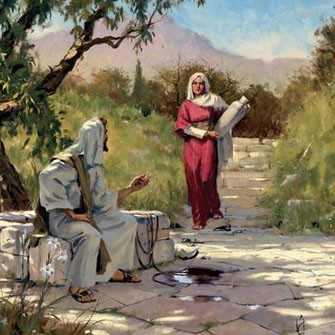

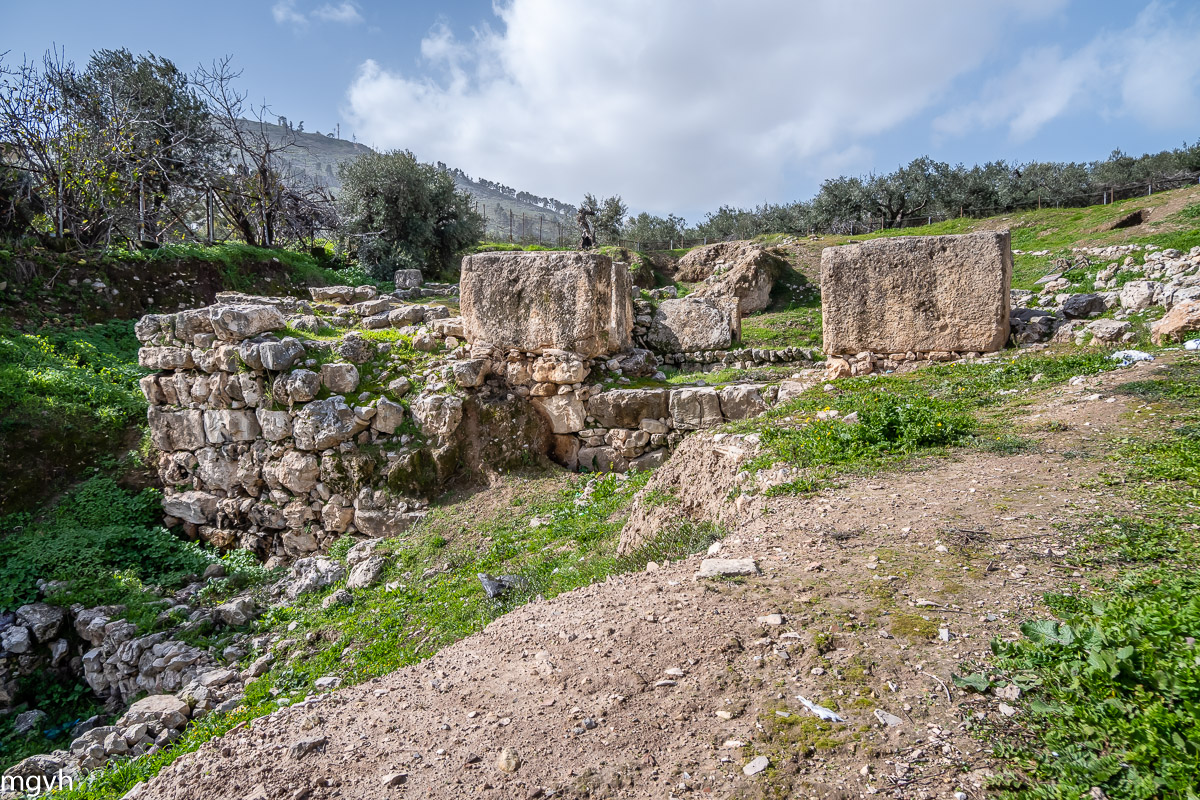
It was to this woman that Jesus identified himself as the Messiah. She was the first to learn who Jesus truly was.
Jesus knew the Pharisees had heard that he was baptizing and making more disciples than John (though Jesus himself didn’t baptize them—his disciples did), so He left Judea to return to Galilee. On his way there, He had to pass through Samaria.

Eventually, he reached the Samaritan village of Sychar, near the field Jacob had given to his son, Joseph. This was where Jacob’s Well was, and Jesus, tired from the journey, sat at the well around noon.

Soon, a Samaritan woman came to draw water, so Jesus said to her, “Please give me a drink,” as He was alone at the time because His disciples had gone into the village to purchase food.

Surprised, as Jews refused to have anything to do with Samaritan, the woman replied, “You are a Jew, and I’m a Samaritan. Why are you asking me for a drink?”

Jesus replied, “If you only knew the gift of God and who it is that asked you for a drink, you would’ve asked him, and he would’ve given you the living water.”

“But sir, you don’t have a rope or a bucket,” she responded. “Besides, the well is very deep. How would you get this living water? Do you think you’re greater than our ancestor, Jacob, who gave us this well, drank from it himself, as did his sons and livestock?”

“Anyone who drinks of this water will soon become thirsty again, but those who drink from the water I give will never be thirsty again,” Jesus answered. “The water I give them will become a spring of water welling up to eternal life.”

“Then give me this water,” she replied. “Then I, too, won’t ever be thirsty again, and I won’t have to come here and get water.”

“Then go get your husband.”

“I don’t have a husband.”

Jesus said to the woman, “You’re right when you say you don’t have a husband, for you’ve had five husbands, and the man you have now isn’t your husband. So, what you said is true.”

“Sir, I can see you’re a prophet. Tell me, why is it that you Jews insist that Jerusalem is the only place of worship when we Samaritans believe that it is at the mountain where our ancestors worshiped?”

“Woman,” Jesus began, “Believe me, there’s a time coming when it wouldn’t matter if you worship the Father on a mountain or at Jerusalem. You Samaritans worship what you don’t know, while we worship what we know, for salvation is from the Jews. There is a time coming—in fact, it is here now—when the true worshipers will worship the Father in Spirit and Truth. The Father seeks those who will worship Him in this way, for God is Spirit, and so those who worship must do so in Spirit and in Truth.”

The woman said, “The Messiah is coming. When he comes, he’ll explain everything.”

Jesus answered, “I am He.”

John 4:1-26
Bring Your Husband
I often wondered why Jesus asked the Samaritan woman to bring her husband. Was it because He wanted to intentionally reveal her past life, or was there another purpose this question served?

During the conversation, the Samaritan woman perhaps believed that Jesus was offering her literal water, yet when she discovered that Jesus may have been a prophet, she switched her conversation to one of theology, not realizing that Jesus had been giving her a theological lesson all along.
Sometimes, at a surface level, it’s easy to get caught up in the moment—not recognizing a deeper truth to a message being relayed to us. It certainly was the case for me. When the Samaritan woman asked to receive this ‘living water’, and Jesus asked to meet her husband, her response was a bit … strange.
Yet, Jesus highlighted an issue that many women face today. Returning to the town of Sychar, where Jacob’s well was and where he met Rachel, an entire narrative unfolds before our very eyes.
Rachel and Leah competed for Jacob’s affection through any means necessary, almost to the point of degradation, when they began to drag their maidservants into their messy competition of who could bear Jacob the most children.
At one point, Leah and Rachel’s tension as sisters rose so high, that they began to sell themselves for mandrakes.
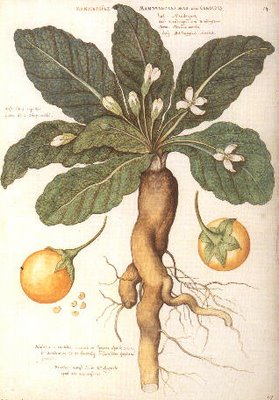
If you don’t know what mandrakes are, they were herbal plants used in ancient cultures as a popular stimulant—like an aphrodisiac—and many women thought they helped with fertility. When Leah’s son brought home mandrakes, Rachel was desperate for them.
Leah used the mandrakes as a way to get her one night with Jacob (apparently, it was Rachel’s night). In fact, she said to Jacob herself that ‘she hired Jacob with mandrakes.
In the days of wheat harvest, Reuben went and found mandrakes in the field and brought them to his mother Leah. Then Rachel said to Leah, “Please give me some of your son’s mandrakes.” But she said to her, “Is it a small matter that you have taken away my husband? Would you take away my son’s mandrakes also?” Rachel said, “Then he may lie with you tonight in exchange for your son’s mandrakes.” When Jacob came from the field in the evening, Leah went out to meet him and said, “You must come into me, for I have hired you with my son’s mandrakes.” So he lay with her that night.
Genesis 30:14-16
If you’re thinking ‘desperate’, then you’re also thinking ‘these women were thirsty’.
It is no coincidence that Jesus met the Samaritan woman at this particular well. This passage highlights an issue many women face today: our struggles to understand that God is our sole source of intimacy. In fact, Jesus’ explanation of worship with the Father is intimate.
At the time, both the Samaritans and Jews disagreed with how worship should be carried out, but Jesus explained that worship was intimate in nature—one that could only be done in spirit and truth.
Should we desire Him and Him alone, we would never ‘thirst’ again.
And the Lord will guide you continually and satisfy your desire in scorched places and make your bones strong; and you shall be like a watered garden, like a spring of water, whose waters do not fail.
Isaiah 58:11
God’s love fills us and satisfies us like a well that can never run dry—a spring that doesn’t fail. In the Old Testament, He used Israel to illustrate marriage, the true form of devotion and intimacy between a husband and his bride.
The word of the Lord came to me, saying, “Go and proclaim in the hearing of Jerusalem”, Thus says the Lord,
“‘I remember the devotion of your youth, how as a bride you loved me and followed me through the wilderness, through a land not sown. Israel was holy to the Lord, the first fruits of his harvest; all who devoured her were held guilty, and disaster overtook them,’” declares the Lord.
Jeremiah 2:1-3 NIV
Yet, just like Israel, even today, we desire other things over God. Israel committed the heinous act of worshiping false idols, neglecting to honor their covenant with the True and Living God. In this, they committed two sins:
- They neglected the Spring of Living Water
- They dug their own broken cisterns that couldn’t hold anything
Has a nation ever changed its gods? (Yet they are not gods at all.) But my people have exchanged their glorious God for worthless idols. Be appalled at this, you heavens, and shudder with great horror,” declares the Lord. “My people have committed two sins: They have forsaken me, the spring of living water, and have dug their own cisterns, broken cisterns that cannot hold water.
Jeremiah 2:11-13 NIV
Continuously thirsty, we chase after things that are not of God’s own heart and pray for husbands because we believe that God cannot holistically satisfy us.
Sexual sin will always be prevalent because of this broken unity from the beginning. But God is able to restore that by providing for us the Holy Spirit—a new covenant we can become one with—a covenant that will never leave us dissatisfied.
Perhaps this Samaritan woman was struggling with this very thing—Jesus illustrated her lifestyle and showed her that something was lacking in her life.
Christ is the Living Water, the spring that never runs dry.
Dirty Vessels Deserve Dirty Truths
Are you a dirty vessel?
I sure am. We all are. And for that, we deserve dirty truths.
Sometimes we let our past (and present) define us. Maybe we struggled with this ‘thirsty’ thing all our lives, or perhaps this has become a recent struggle and a hurdle we have no idea how to get over.
Then, my friend, you have become a dirty vessel. But you deserve to know the truth.
Thus says the Lord God to Jerusalem:
“Your origin and your birth are of the land of the Canaanites; your father was an Amorite and your mother a Hittite. And as for your birth, on the day you were born, your cord was not cut, nor were you washed with water to cleanse you, nor rubbed with salt, nor wrapped in swaddling cloths. No eye pitied you, to do any of these things to you out of compassion for you, but you were cast out on the open field, for you were abhorred, on the day that you were born.
“And when I passed by you and saw you wallowing in your blood, I said to you in your blood, ‘Live!’ I said to you in your blood, ‘Live!’ 7 I made you flourish like a plant of the field. And you grew up and became tall and arrived at full adornment. Your breasts were formed, and your hair had grown, yet you were naked and bare.
“When I passed by you again and saw you behold, you were at the age for love, and I spread the corner of my garment over you and covered your nakedness; I made my vow to you and entered into a covenant with you, declares the Lord God, and you became mine. Then I bathed you with water and washed off your blood from you and anointed you with oil. I clothed you also with embroidered cloth and shod you with fine leather. I wrapped you in fine linen and covered you with silk. And I adorned you with ornaments and put bracelets on your wrists and a chain on your neck. And I put a ring on your nose and earrings in your ears and a beautiful crown on your head. Thus you were adorned with gold and silver, and your clothing was of fine linen and silk and embroidered cloth. You ate fine flour and honey and oil. You grew exceedingly beautiful and advanced to royalty. And your renown went forth among the nations because of your beauty, for it was perfect through the splendor that I had bestowed on you”, declares the Lord God.
Ezekiel 16:3-14
Even though God had taken Israel, cleaned her up, and made her His, Israel made the mistake of chasing after other gods, trusting in her own beauty and splendor rather than the grace that God had given her.
But the truth is…
We don’t have to become like Israel. God, sent His son to redeem us back to Himself.
Check out the latest in SHE GLOWS

To the Girl with No Identity…
Struggling with my identity in college was the very thing that helped me find my way to God.
In ancient Hebrew culture, the redeemer (goel) was the person (usually a relative) who was sent out to restore a person’s rights if they were wronged. The redeemer operated in four primary functions:
- To redeem an Israelite who had become a slave
- To repurchase property that was sold because of poverty
- To avenge the murder of a close relative
- To restore a widow’s rights if her former husband died without leaving an heir
For your Maker is your husband—
the Lord Almighty is His name—
the Holy One of Israel is your Redeemer;
He is called the God of all the earth.Isaiah 54:5 ESV
God becomes our ultimate redemption, sending His son to perform the task of the Redeemer.
The Year of the Lord’s Favor
Christ was favored to become the liberator of those in captivity and the redeemer of those who were sold to slavery, left without an inheritance, and wrought with shame.
The Spirit of the Lord God is upon me because the Lord has anointed me to bring good news to the poor;
he has sent me to bind up the brokenhearted, to proclaim liberty to the captives, and the opening of the prison to those who are bound
to proclaim the year of the Lord’s favor and the day of vengeance of our God;
to comfort all who mourn; to grant to those who mourn in Zion—to give them a beautiful headdress instead of ashes, the oil of gladness instead of mourning, the garment of praise instead of a faint spirit;
that they may be called oaks of righteousness, the planting of the Lord, that he may be glorified.Isaiah 61:1-2 ESV
He came to bring the Good News to those who feel like a dirty vessel, cast aside by their family and community—those like the Samaritan woman who had to fetch her water at noon.
To her, Christ was the Good News. He was the Messiah she had waited for, and she was the first to proclaim the Gospel to her hometown. Because of this, many believed in Christ, saying that He was the Savior of the world.
Through this, we receive God’s unmerited love and favor.
For His anger lasts only a moment, but his favor lasts a lifetime; weeping may stay for the night, but rejoicing comes in the morning.
Psalms 30:5 NIV
A Husband Like Christ
To the woman who prays for a husband, pray instead for God’s living water.
We should have no other want or desire but God. When our hearts are fully in God, if it is in His will, He will lead us to the person He knows is the perfect ambassador of the covenant He made with us.
For the Lord God is a sun and shield; the Lord bestows favor and honor. No good thing does He withhold from those who walk uprightly.
Psalms 84:11 ESV
God can cover us and give us a heart that thirsts for Him alone.
As the deer pants for streams of water,
so my soul pants for you, my God.
My soul thirsts for God, for the living God.
When can I go and meet with God?Psalms 42:1-2 NIV
Whether or not we are single, God is our ultimate defender. A father to the fatherless and a defender of widows is God in His holy habitation.
For your Maker is your husband—
the Lord Almighty is His name—
the Holy One of Israel is your Redeemer;
He is called the God of all the earth.Isaiah 54:5 ESV
God’s Word to You
I have blotted out your transgressions like a cloud and your sins like mist; return to me, for I have redeemed you.
Isaiah 44:22
This was previously posted on Becoming the Oil and Wine. Read the original here.

Strengthen your faith and grow with God. Get new bible-study content delivered right to your inbox.



 The RAVYN Blog